
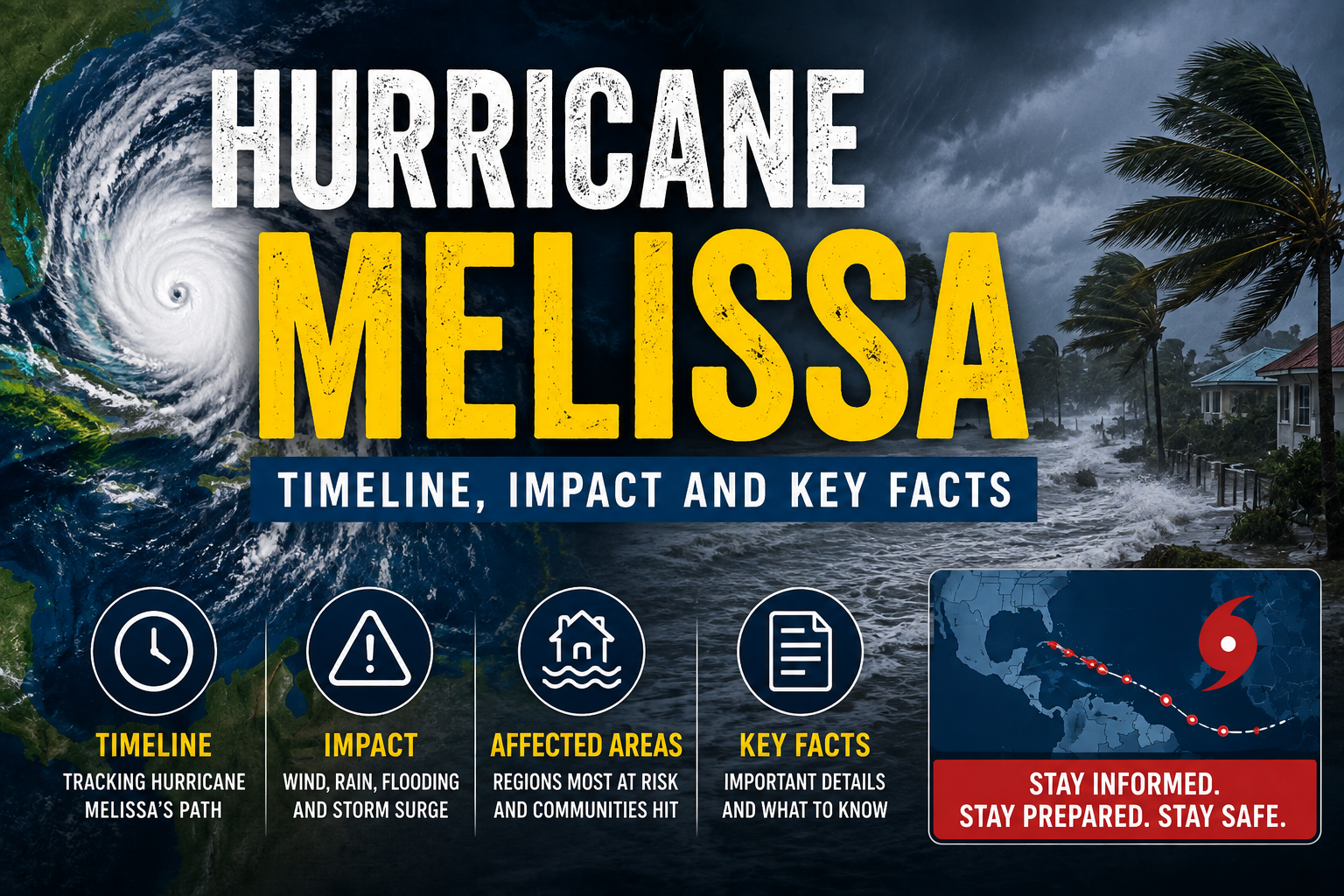

Hurricane Melissa: Timeline, Impact and Key Facts
Hurricane Melissa was one of the most powerful and destructive hurricanes of the 2025 Atlantic season. After rapidly intensifying over the Caribbean Sea, the storm struck Jamaica on October 28, 2025, as a Category 5 hurricane with estimated maximum sustained winds of 185 mph (295 km/h).
- Hurricane Melissa: Timeline, Impact and Key Facts
- Key Takeaways
- Main Article
- What Was Hurricane Melissa?
- Hurricane Melissa Timeline
- Why Was Hurricane Melissa So Powerful?
- Hurricane Melissa’s Impact on Jamaica
- Infrastructure and Public Services
- Agriculture and Tourism
- Humanitarian Impact Across the Caribbean
- How Much Damage Did Hurricane Melissa Cause?
- Why Hurricane Melissa Matters for Disaster Preparedness
- Jamaica’s Financial Preparedness After Melissa
- What Made Melissa Different From an Ordinary Hurricane?
- Frequently Asked Questions
- When did Hurricane Melissa hit Jamaica?
- How strong was Hurricane Melissa?
- Was Hurricane Melissa a Category 5 hurricane?
- Where did Hurricane Melissa make landfall?
- Which countries were affected by Hurricane Melissa?
- How much damage did Hurricane Melissa cause in Jamaica?
- Why did Hurricane Melissa intensify so quickly?
- What happened to Hurricane Melissa after Jamaica?
- Conclusion
The storm was particularly devastating because of its combination of extreme winds, torrential rainfall, flooding, storm surge, and a direct passage across Jamaica. It later moved toward Cuba and the Bahamas, leaving significant impacts across several Caribbean countries.
Hurricane Melissa also became important beyond the immediate disaster. Its damage exposed the vulnerability of homes, infrastructure, agriculture, tourism, and public services across the region while highlighting the value of disaster preparedness and pre-arranged emergency financing.
This guide explains the Hurricane Melissa timeline, how the storm developed, where it traveled, why it became so powerful, and what the hurricane meant for Jamaica and the wider Caribbean.
Key Takeaways
- Hurricane Melissa made landfall in Jamaica on October 28, 2025, near New Hope in southwestern Jamaica.
- It reached Category 5 intensity, with maximum sustained winds estimated at 185 mph (295 km/h) and a minimum central pressure of 892 mb near landfall.
- Jamaica experienced catastrophic wind damage, flooding, infrastructure failures, agricultural losses, and widespread debris.
- The World Bank and Inter-American Development Bank initially estimated US$8.8 billion in physical damage to Jamaica, equivalent to roughly 41% of the country’s 2024 GDP.
- Hurricane Melissa also affected Haiti, Cuba, and The Bahamas, with regional humanitarian consequences.
- The storm demonstrated how rapid intensification, exceptionally warm Caribbean waters, and favorable atmospheric conditions can produce an extremely dangerous hurricane.
Main Article
What Was Hurricane Melissa?
Hurricane Melissa was a major Atlantic tropical cyclone that developed in the Caribbean Sea in October 2025.
It became the 13th named storm, fifth hurricane, fourth major hurricane, and third Category 5 hurricane of the 2025 Atlantic hurricane season, according to a later United Nations assessment.
The storm became especially notable because it intensified dramatically before reaching Jamaica. By October 28, Melissa had reached an estimated 185 mph in maximum sustained winds and a central pressure of 892 mb.
Those measurements placed Melissa among the most powerful Atlantic hurricanes ever observed at landfall. The National Hurricane Center described its Jamaica landfall as one of the most powerful hurricane landfalls on record in the Atlantic basin.
Hurricane Melissa Timeline
Understanding the storm’s timeline helps explain how quickly the situation evolved.
October 24: Tropical Storm Melissa Develops
Melissa was already strengthening in the Caribbean by October 24. Conditions around the storm became increasingly favorable for further development.
At this stage, forecasters were watching the system closely because of its proximity to Jamaica, Haiti and other vulnerable Caribbean locations.
October 25: Melissa Becomes a Hurricane
On October 25, Melissa strengthened into a hurricane.
The National Hurricane Center warned that the system could rapidly intensify into a major hurricane while also highlighting the threat of catastrophic flash flooding and landslides across parts of Jamaica and southern Hispaniola.
By that evening, Melissa had reached winds of approximately 100 mph.
October 26: Rapid Intensification Continues
On October 26, Hurricane Melissa continued strengthening while moving slowly westward.
The storm’s maximum sustained winds reached about 140 mph, making it a Category 4 hurricane. Forecasts continued to emphasize dangerous rainfall, flooding and landslides in Jamaica and Hispaniola.
Its relatively slow movement was another concern because prolonged rainfall can increase flooding and landslide risks.
October 27: Melissa Approaches Jamaica
As Melissa approached Jamaica, the storm remained extremely powerful.
Forecasters and emergency authorities increasingly focused on the likelihood of a catastrophic impact. The combination of very strong winds and the storm’s slow approach gave communities limited room for error.
October 28: Category 5 Landfall in Jamaica
October 28 became the defining day of Hurricane Melissa.
The hurricane made landfall near New Hope in southwestern Jamaica with estimated maximum sustained winds of 185 mph and a minimum central pressure of 892 mb.
Melissa then crossed Jamaica from southwest toward northeast.
The storm’s passage produced catastrophic winds and severe rainfall while damaging homes, roads, utility infrastructure, public buildings and agricultural areas.
The hurricane weakened considerably while crossing the island because Jamaica’s mountainous terrain disrupted its circulation. Even so, Melissa remained an exceptionally dangerous system.
October 29: Melissa Hits Cuba
After crossing Jamaica, Hurricane Melissa moved toward Cuba.
The National Hurricane Center reported that Melissa made landfall in Santiago de Cuba early on October 29 with an estimated landfall intensity of 105 knots. The hurricane then moved inland across eastern Cuba while producing damaging winds and heavy rainfall.
After Cuba: Continued Caribbean Impacts
Melissa subsequently affected other areas of the Caribbean, including parts of the Bahamas.
The storm’s broader regional effects extended beyond wind damage. Heavy rainfall, flooding, damaged infrastructure, disrupted transportation and displacement created humanitarian challenges across multiple countries.
Why Was Hurricane Melissa So Powerful?
One of the most important questions surrounding Hurricane Melissa is why it intensified so dramatically.
The answer involves several environmental factors rather than one single cause.
Exceptionally Warm Ocean Water
Tropical cyclones draw energy from warm ocean water. Higher sea surface temperatures can provide more heat and moisture to a developing hurricane.
The United Nations’ assessment of Melissa identified exceptionally high sea surface temperatures and elevated ocean heat content among the environmental conditions supporting the storm’s rapid intensification.
Low Wind Shear
Vertical wind shear refers to changes in wind speed or direction with height.
Strong wind shear can disrupt a tropical cyclone by tilting or weakening its circulation. Melissa developed in an environment with relatively low wind shear, allowing its inner structure to organize efficiently.
Rapid Intensification
Melissa’s strengthening was particularly significant because it occurred over a relatively short period.
Rapid intensification is dangerous because communities and emergency managers can have less time to adjust preparations as forecasts change.
For residents, this is an important hurricane-preparedness lesson: a tropical storm or lower-category hurricane can become considerably stronger before landfall when atmospheric and oceanic conditions are favorable.
Hurricane Melissa’s Impact on Jamaica
Jamaica experienced the most severe direct effects of Hurricane Melissa.
The storm crossed the island with extreme winds, heavy rainfall and flooding. Western parishes were particularly hard hit, including St. Elizabeth and Westmoreland.
Satellite-based analysis by the United Nations Development Programme estimated that more than 4.8 million tonnes of debris were left across western Jamaica. That debris blocked roads and disrupted access to schools, hospitals, clinics, farms and markets.
Some areas experienced extraordinary levels of structural damage. UNDP reported that tens of thousands of homes were damaged, while some communities experienced impacts to as much as 90% of buildings.
Damage to Homes and Buildings
High winds from a Category 5 hurricane can destroy roofs, walls, windows and entire structures.
In Jamaica, residential buildings represented the largest share of the physical damage identified in the World Bank’s initial rapid assessment.
The assessment found:
| Sector | Share of assessed physical damage |
|---|---|
| Residential buildings | 41% |
| Infrastructure | 33% |
| Non-residential buildings | 21% |
| Agriculture | 5% |
The initial assessment estimated Jamaica’s physical damage at approximately US$8.8 billion.
That figure represents physical damage rather than the complete economic cost of the disaster.
Infrastructure and Public Services
Hurricane Melissa damaged essential infrastructure across Jamaica.
Roads were blocked by trees, vegetation, utility poles and structural debris. Damage to transportation networks made it harder for emergency teams to reach affected communities.
Electricity and communications were also disrupted.
Hospitals, schools and other public facilities faced damage or access problems, making recovery more difficult precisely when communities needed services most.
The scale of debris created an additional challenge. Clearing roads was not simply a matter of removing a few fallen trees; millions of tonnes of material had to be managed while emergency services were attempting to restore basic connectivity.
Agriculture and Tourism
Agriculture was another important part of the hurricane’s impact.
Jamaica’s agricultural communities are particularly vulnerable to extreme weather because farms, livestock, crops and agricultural infrastructure can all be damaged simultaneously.
The physical share of agricultural damage was smaller than that of housing and infrastructure in the initial World Bank assessment, but the broader economic consequences were expected to be greater because damaged crops, livestock and production capacity can affect income well after the hurricane has passed.
Tourism also faced disruption.
Jamaica’s economy depends heavily on tourism, and hurricane damage can affect hotels, transportation, attractions, utilities and the wider network of businesses that depend on visitors.
Humanitarian Impact Across the Caribbean
Hurricane Melissa was not solely a Jamaican disaster.
The storm affected several Caribbean countries, including Haiti, Cuba and The Bahamas.
The humanitarian consequences included deaths, displacement, damaged homes, disrupted services and shortages of basic necessities.
A United Nations Development Programme report published in April 2026 said approximately 75 people across the region died because of Melissa’s impacts, according to the UN Office for the Coordination of Humanitarian Affairs.
The figure illustrates why hurricane impacts should be assessed across the entire storm-affected region rather than focusing only on the location of landfall.
How Much Damage Did Hurricane Melissa Cause?
The answer depends on what is being measured.
An early World Bank and Inter-American Development Bank assessment estimated US$8.8 billion in physical damage in Jamaica, making Melissa the costliest hurricane in Jamaica’s recorded history based on that measure.
Later World Bank country information placed the broader combined estimate of damages and losses at approximately US$12.5 billion, or about 60% of Jamaica’s 2024 GDP.
These numbers should not be treated as interchangeable.
Physical damage refers primarily to the cost of damaged or destroyed assets and infrastructure. Economic losses can include interrupted business activity, lost production, reduced tourism revenue and other consequences that continue after the immediate destruction.
That distinction is important when discussing the overall cost of Hurricane Melissa.
Why Hurricane Melissa Matters for Disaster Preparedness
Melissa also provides important lessons about disaster resilience.
Early Preparation Matters
A hurricane’s intensity can change quickly. Waiting until the last possible moment to prepare can leave households with limited options.
Preparation should include:
- Securing vulnerable parts of a home
- Keeping emergency food and drinking water available
- Charging phones and backup power devices
- Protecting important documents
- Knowing evacuation routes
- Following official evacuation instructions
- Checking on vulnerable family members and neighbors
- Avoiding flooded roads and dangerous areas after landfall
Strong Infrastructure Can Reduce Losses
Not every infrastructure project prevents damage, but well-designed resilience measures can make a major difference.
For example, the World Bank reported that an upgraded drainage crossing at Myton Gully in Jamaica withstood the heavy rainfall and flooding associated with Melissa, helping protect homes, livelihoods and an important transport route.
This demonstrates an important principle: disaster resilience is not only about responding after a storm. It is also about investing in stronger infrastructure before the next disaster arrives.
Jamaica’s Financial Preparedness After Melissa
Hurricane Melissa also highlighted the importance of disaster-risk financing.
Before the storm, Jamaica had catastrophe-risk financing mechanisms designed to provide funds quickly after major disasters.
Following Melissa, Jamaica received a full US$150 million payout from a World Bank catastrophe bond after the storm met the predetermined triggers based on its intensity and path.
In May 2026, the World Bank announced a new catastrophe bond providing Jamaica with US$200 million of hurricane insurance coverage for four hurricane seasons. The new arrangement replaced the earlier coverage that had been triggered by Melissa.
This is a significant lesson from the hurricane: recovery depends not only on physical rebuilding but also on having financial resources available quickly.
What Made Melissa Different From an Ordinary Hurricane?
Several characteristics made Hurricane Melissa especially notable:
- Extreme intensity: It reached Category 5 strength.
- Very high winds: Maximum sustained winds reached an estimated 185 mph.
- Very low pressure: Its minimum central pressure fell to 892 mb.
- Direct Jamaican landfall: The storm crossed one of the Caribbean’s most vulnerable island nations.
- Rapid intensification: Melissa strengthened rapidly as conditions became favorable.
- Multiple-country impacts: Jamaica was followed by major effects in Cuba and impacts elsewhere in the Caribbean.
- Large economic consequences: Damage and losses extended across housing, infrastructure, agriculture, tourism and public services.
Frequently Asked Questions
When did Hurricane Melissa hit Jamaica?
Hurricane Melissa made landfall in Jamaica on October 28, 2025, near New Hope in southwestern Jamaica as a Category 5 hurricane.
How strong was Hurricane Melissa?
Near its Jamaican landfall, Melissa had estimated maximum sustained winds of 185 mph (295 km/h) and a minimum central pressure of 892 mb.
Was Hurricane Melissa a Category 5 hurricane?
Yes. Hurricane Melissa reached Category 5 intensity before making landfall in Jamaica. It was the third Category 5 hurricane of the 2025 Atlantic season.
Where did Hurricane Melissa make landfall?
Melissa made landfall near New Hope in southwestern Jamaica, crossing the island before moving toward Cuba.
Which countries were affected by Hurricane Melissa?
The hurricane affected Jamaica, Haiti, Cuba and The Bahamas, with impacts varying by location.
How much damage did Hurricane Melissa cause in Jamaica?
The World Bank and Inter-American Development Bank initially estimated Jamaica’s physical damage at about US$8.8 billion. Later estimates that included broader damages and losses were higher.
Why did Hurricane Melissa intensify so quickly?
Melissa developed in an unusually favorable environment characterized by very warm ocean temperatures, high ocean heat content and low wind shear. These conditions supported rapid intensification.
What happened to Hurricane Melissa after Jamaica?
After crossing Jamaica, Melissa moved toward eastern Cuba and made landfall in Santiago de Cuba on October 29, 2025. It then continued through the Caribbean, affecting other areas including the Bahamas.
Conclusion
Hurricane Melissa stands as one of the defining Atlantic hurricanes of 2025 and one of the most powerful storms ever to strike Jamaica.
Its October 28 landfall demonstrated the destructive potential of a Category 5 hurricane when extreme winds, heavy rainfall, flooding and storm surge affect densely populated and economically important areas. The storm caused enormous physical damage in Jamaica, disrupted essential services and created humanitarian consequences across the wider Caribbean.
But the story of Hurricane Melissa is also about preparation and recovery. Jamaica’s experience showed the value of resilient infrastructure, emergency planning and financial mechanisms that can release funds quickly after a disaster.
The hurricane’s legacy will therefore extend beyond the destruction recorded in October 2025. It has become an important case study in hurricane forecasting, rapid intensification, disaster preparedness, infrastructure resilience and long-term Caribbean recovery.