
The Women History Could Not Ignore
History has never been shaped by one kind of person. It has been built by rulers, scientists, writers, activists, warriors, teachers, inventors, and ordinary people who chose to do something extraordinary. Yet for far too long, many women who helped change the world were pushed into the background.
- The Women History Could Not Ignore
- Why Historical Figures Female Pioneers Still Matter Today
- Quick Bio Table of Famous Female Historical Figures
- Marie Curie: The Scientist Who Changed the Future
- Rosa Parks: The Woman Whose Quiet Strength Moved a Nation
- Ada Lovelace: The Visionary Behind Early Computing
- Amelia Earhart: The Aviator Who Refused Limits
- Cleopatra: More Than a Beautiful Queen
- Harriet Tubman: Courage in Its Purest Form
- Florence Nightingale: The Woman Who Transformed Nursing
- Frida Kahlo: The Artist Who Turned Pain Into Power
- Other Female Pioneers Who Deserve Recognition
- Common Traits Shared by Historical Figures Female Pioneers
- How Female Historical Figures Changed Society
- Why Their Stories Are Still Powerful for Young Readers
- Lessons We Can Learn From Female Pioneers
- The Importance of Remembering Women Correctly
- How to Use These Stories in Daily Life
- Conclusion: The Women Who Changed the Rules
That is why the topic of Historical Figures Female pioneers matters so much.
These women did not simply “take part” in history.
When we talk about Historical Figures Female pioneers, we are not just talking about the past. We are talking about courage that still feels fresh today. Their lives remind us that progress is rarely easy. It often begins with one person refusing to accept the limits placed on them.
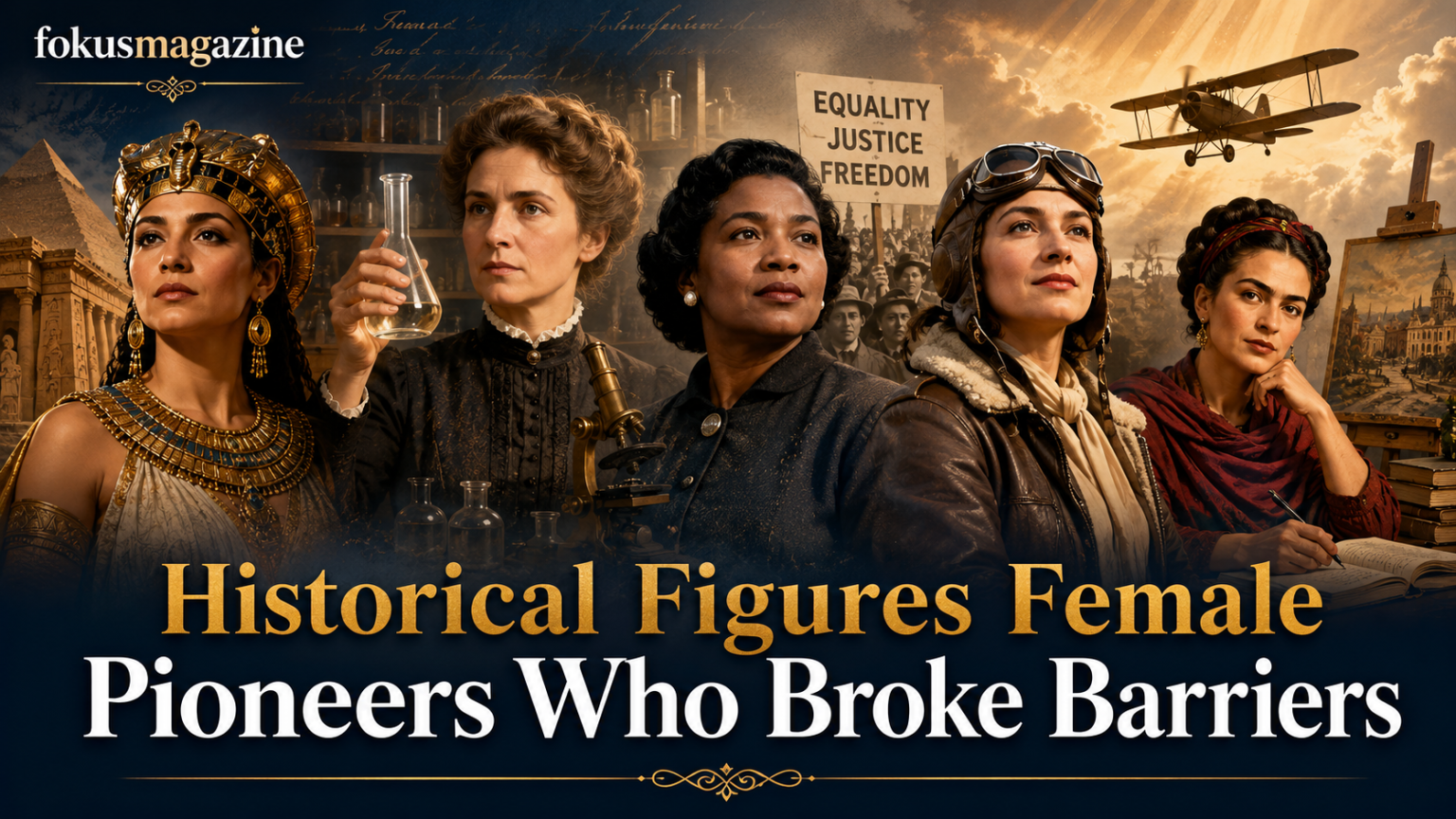
From Cleopatra to Marie Curie, from Rosa Parks to Malala Yousafzai, from Ada Lovelace to Amelia Earhart, these female pioneers broke barriers in politics, science, education, aviation, civil rights, literature, medicine, and social justice. Their stories are full of struggle, but also full of strength.
Let’s look at the women who changed the course of history and why their influence still matters.
Why Historical Figures Female Pioneers Still Matter Today
The study of Historical Figures Female leaders is not only about remembering famous women. It is about understanding how change happens. Many of these women lived in times when society had strict ideas about what women could or could not do. Others risked prison, exile, violence, or public shame.
Still, they moved forward.
Their stories help modern readers see how rights, freedoms, and opportunities were won. They also show young girls and women that greatness has never belonged to one gender. Talent, courage, intelligence, and leadership can come from anywhere.
In addition, these women help us understand history in a fuller way. When we only study kings, generals, and male inventors, we miss half the picture. Women were always there. They were advising rulers, writing books, leading protests, making discoveries, caring for communities, and changing minds.
Quick Bio Table of Famous Female Historical Figures
| Full Name | Date of Birth | Age | Profession | Nationality | Net Worth (approx.) | Notable Works / Achievements |
|---|---|---|---|---|---|---|
| Marie Curie | November 7, 1867 | 66 at death | Scientist, Physicist, Chemist | Polish-French | Not applicable | First woman to win a Nobel Prize; research on radioactivity |
| Rosa Parks | February 4, 1913 | 92 at death | Civil Rights Activist | American | Not publicly confirmed | Key figure in the Montgomery Bus Boycott |
| Ada Lovelace | December 10, 1815 | 36 at death | Mathematician, Writer | British | Not applicable | Often called the first computer programmer |
| Amelia Earhart | July 24, 1897 | 39 at disappearance | Aviator, Author | American | Not publicly confirmed | First woman to fly solo across the Atlantic |
| Cleopatra VII | 69 BC | 39 at death | Queen, Political Leader | Egyptian | Not applicable | Last active ruler of the Ptolemaic Kingdom of Egypt |
| Harriet Tubman | Around March 1822 | About 91 at death | Abolitionist, Activist | American | Not applicable | Helped enslaved people escape through the Underground Railroad |
| Florence Nightingale | May 12, 1820 | 90 at death | Nurse, Reformer | British | Not applicable | Founder of modern nursing |
| Frida Kahlo | July 6, 1907 | 47 at death | Painter | Mexican | Not publicly confirmed | Iconic self-portraits and cultural influence |
Marie Curie: The Scientist Who Changed the Future
Among Historical Figures Female pioneers, Marie Curie stands as one of the brightest names in science. Born in Poland and later based in France, she became famous for her groundbreaking research on radioactivity. At a time when women were often discouraged from entering scientific fields, Curie pushed forward with deep focus and remarkable discipline.
She became the first woman to win a Nobel Prize. Even more impressively, she won Nobel Prizes in two different scientific fields: physics and chemistry. That alone makes her one of the most important scientists in modern history.
What makes Curie’s story powerful is not just the awards. It is the sacrifice behind the work. She spent long hours in poor laboratory conditions, often with limited resources. Her research helped shape medical treatment, especially in the use of radiation for disease diagnosis and therapy.
Marie Curie proved that intelligence has no gender. Her life still inspires scientists, students, doctors, and researchers around the world.
Why Marie Curie Broke Barriers
Marie Curie broke barriers because she entered a male-dominated field and earned respect through undeniable work. She did not wait for permission to be brilliant. She simply worked until the world had to notice.
Her story adds real depth to any discussion of Historical Figures Female leaders because she represents patience, courage, and intellectual power.
Rosa Parks: The Woman Whose Quiet Strength Moved a Nation
Rosa Parks is often remembered for one simple act: refusing to give up her bus seat in Montgomery, Alabama. However, her story is far bigger than that single moment. Parks was already involved in civil rights work before her famous arrest in 1955. She understood the risks. She knew the system was unfair. And she made a choice that helped ignite a major movement.
Her refusal led to the Montgomery Bus Boycott, one of the most important campaigns in the American civil rights movement. The boycott lasted more than a year and became a turning point in the fight against racial segregation.
Rosa Parks showed the world that resistance does not always need to be loud to be powerful. Sometimes, history changes when one person calmly says, “No.”
The Legacy of Rosa Parks
Rosa Parks remains one of the most respected Historical Figures Female icons because her courage was both personal and political. She stood up not only for herself but for millions of people who were tired of injustice.
Her legacy is a reminder that ordinary moments can become historic when they are filled with purpose.
Ada Lovelace: The Visionary Behind Early Computing
Long before laptops, smartphones, websites, and apps existed, Ada Lovelace imagined the future of machines. Born in 1815, she worked with Charles Babbage, who designed an early mechanical computer called the Analytical Engine.
Ada Lovelace wrote notes explaining how the machine could do more than simple calculation. She saw that machines might one day work with symbols, music, and complex ideas. Because of this, many people call her the first computer programmer.
That is remarkable, especially when we remember the time she lived in. Women in the 1800s were not usually encouraged to study mathematics deeply. Yet Lovelace had a rare mind and a powerful imagination.
Why Ada Lovelace Still Matters
Ada Lovelace matters because she saw possibilities before the rest of the world was ready. She belongs among Historical Figures Female pioneers because her ideas helped shape the digital age.
Every time we talk about women in technology, coding, software, or innovation, Ada Lovelace deserves a place in the conversation.
Amelia Earhart: The Aviator Who Refused Limits
Amelia Earhart became one of the most famous pilots in history. She was the first woman to fly solo across the Atlantic Ocean, a dangerous and daring achievement at the time. Aviation was still young, and many people believed flying was too risky or too technical for women.
Earhart did not agree.
She loved adventure. She loved freedom. More importantly, she wanted women to be seen as capable of doing bold and difficult things. Her flights made headlines, but her deeper mission was about possibility.
She once represented a kind of fearless modern womanhood that inspired people across the world. Although her disappearance during an attempt to fly around the globe remains one of history’s great mysteries, her legacy continues to fly high.
Amelia Earhart’s Lasting Influence
Earhart is one of those Historical Figures Female readers remember because her story feels cinematic. Yet behind the adventure was a serious message: women should not be limited by fear, tradition, or public opinion.
Cleopatra: More Than a Beautiful Queen
Cleopatra VII is often described through beauty and romance, but that narrow view does not do her justice. She was a skilled political leader, a diplomat, and one of the most intelligent rulers of the ancient world. As the last active ruler of the Ptolemaic Kingdom of Egypt, she worked hard to protect her country’s power during a dangerous time.
Cleopatra spoke multiple languages and understood politics deeply. She formed alliances with powerful Roman leaders, including Julius Caesar and Mark Antony. Her life was filled with drama, but it was also filled with strategy.
Many old stories about Cleopatra were written by people who wanted to weaken her image. Today, more readers see her as a complex and capable ruler.
Cleopatra’s Place in Female History
Cleopatra deserves attention among Historical Figures Female pioneers because she ruled in a world controlled mostly by men. She used intelligence, charm, language, and political skill to defend her kingdom.
Her story shows that women in power have often been judged differently, even when they were highly capable.
Harriet Tubman: Courage in Its Purest Form
Harriet Tubman was born into slavery, escaped, and then returned again and again to help others find freedom. That level of courage is hard to fully imagine. She risked her life many times as part of the Underground Railroad, guiding enslaved people toward safer places.
Tubman was not only brave; she was strategic. She understood routes, timing, secrecy, and trust. Later, during the American Civil War, she also worked as a scout, nurse, and spy.
Her life was shaped by danger, but she never allowed fear to control her mission.
Why Harriet Tubman Is an Unforgettable Pioneer
Harriet Tubman stands among the greatest Historical Figures Female examples because she turned her own freedom into a mission to free others. She did not simply escape oppression. She fought it.
Her story continues to inspire activists, teachers, historians, and anyone who believes justice is worth sacrifice.
Florence Nightingale: The Woman Who Transformed Nursing
Florence Nightingale changed the way the world understood nursing. During the Crimean War, she became known for caring for wounded soldiers and improving hospital conditions. At the time, medical care was often unclean, disorganized, and dangerous.
Nightingale used observation, records, and practical reform to improve patient care. She showed that nursing required knowledge, discipline, and serious training. Because of her work, nursing became a respected profession.
She also used statistics to explain health problems and push for reform. That made her not only a caregiver but also a smart public health thinker.
Florence Nightingale’s Human Impact
Florence Nightingale is one of the most respected Historical Figures Female names in medicine because she changed systems, not just individual lives. Her work helped hospitals become cleaner, safer, and more professional.
Her legacy is still visible in modern healthcare.
Frida Kahlo: The Artist Who Turned Pain Into Power
Frida Kahlo’s art is instantly recognizable. Her self-portraits are bold, emotional, colorful, and deeply personal. Born in Mexico, she lived with physical pain after a serious accident as a young woman. Instead of hiding her suffering, she painted it.
Kahlo explored identity, body image, culture, love, heartbreak, and personal struggle. Her work was not soft or polite. It was honest. That honesty is one reason people still connect with her today.
She also celebrated Mexican culture through clothing, symbols, and style. Over time, she became more than an artist. She became an icon of self-expression.
Why Frida Kahlo Still Speaks to Modern Readers
Frida Kahlo belongs among Historical Figures Female pioneers because she refused to make herself smaller. She turned pain into art and personal truth into global influence.
Her life shows that creativity can become a form of survival.
Other Female Pioneers Who Deserve Recognition
History is full of women who broke barriers. Some are world-famous, while others are still not discussed enough. Here are more powerful names worth knowing:
- Sojourner Truth: A former enslaved woman who became a strong voice for abolition and women’s rights.
- Jane Austen: A novelist whose sharp social observations still influence literature today.
- Indira Gandhi: India’s first female prime minister and a major political figure.
- Mother Teresa: Known for her humanitarian work with poor and sick communities.
- Wangari Maathai: Environmental activist and Nobel Peace Prize winner.
- Emmeline Pankhurst: A leading figure in the British women’s suffrage movement.
- Malala Yousafzai: Education activist who became a global symbol of girls’ right to learn.
- Bessie Coleman: The first African American and Native American woman pilot.
- Junko Tabei: The first woman to reach the summit of Mount Everest.
- Hedy Lamarr: Actress and inventor whose ideas helped influence wireless technology.
These women came from different countries, cultures, and centuries. However, they all shared one thing: they challenged limits.
Common Traits Shared by Historical Figures Female Pioneers
When we look closely at Historical Figures Female pioneers, patterns begin to appear. Their stories are different, but many of their qualities are similar.
Courage
Almost every woman on this list faced pressure, criticism, or danger. Courage helped them continue when quitting would have been easier.
Vision
They saw a future others could not see. Ada Lovelace imagined computing. Florence Nightingale imagined better hospitals. Rosa Parks imagined a fairer society.
Discipline
Great change rarely happens overnight. These women worked, studied, practiced, organized, wrote, spoke, and kept going.
Purpose
They were not chasing fame alone. Many were driven by justice, truth, discovery, freedom, art, or public service.
Resilience
Failure, rejection, illness, discrimination, and loss touched many of their lives. Still, they found ways to continue.
How Female Historical Figures Changed Society
The impact of Historical Figures Female leaders can be seen in almost every part of modern life.
Their influence also changed how people think about women’s roles. They proved women could lead countries, fly planes, write classics, build movements, study science, and shape public opinion.
Because of them, more women entered universities, workplaces, politics, sports, research labs, and leadership positions. Their victories were not perfect or complete, but they opened important doors.
Why Their Stories Are Still Powerful for Young Readers
Young readers need stories that feel real. They need examples of people who struggled, doubted, failed, and still made a difference. That is why Historical Figures Female stories are so valuable in schools, blogs, books, documentaries, and family conversations.
These women were not perfect. That makes them even more inspiring. But they acted anyway.
Lessons We Can Learn From Female Pioneers
The lives of these women offer simple but powerful lessons.
Speak When It Matters
Rosa Parks showed that one firm choice can create a movement. Speaking up does not always mean shouting. Sometimes it means refusing to accept what is wrong.
Keep Learning
Marie Curie and Ada Lovelace remind us that knowledge is power. Education can open doors that society tries to close.
Use Pain Creatively
Frida Kahlo transformed suffering into art. Her life shows that even difficult experiences can become meaningful.
Help Others Rise
Harriet Tubman did not stop after saving herself. She went back to help others. True leadership often means bringing people with you.
Challenge the Story
Cleopatra’s image was shaped by biased history for centuries. Her story teaches us to question what we read and look deeper.
The Importance of Remembering Women Correctly
One problem with history is that women are often simplified. Cleopatra becomes only a beauty. Rosa Parks becomes only a tired woman on a bus. Frida Kahlo becomes only a face on posters. Marie Curie becomes only a Nobel Prize winner.
But real people are more complex than that.
To remember Historical Figures Female pioneers correctly, we need to tell richer stories. We need to include their ideas, struggles, choices, and achievements. We need to see them as thinkers, leaders, creators, and decision-makers.
This is not about rewriting history unfairly. It is about telling history more completely.
How to Use These Stories in Daily Life
These stories are not only useful for school projects or history blogs. They can inspire daily action.>If you are learning something difficult, think of Marie Curie.
>If you feel unheard, think of Rosa Parks.
>If you want to create something honest, think of Frida Kahlo.
>If you want to help others, think of Harriet Tubman.
>If you want to lead with intelligence, think of Cleopatra.
The point is not to copy their lives. The point is to borrow their courage.
Conclusion: The Women Who Changed the Rules
The story of Historical Figures Female pioneers is not a small chapter in history. It is one of the strongest parts of the human story. These women broke barriers in science, politics, civil rights, medicine, aviation, literature, technology, art, and social reform. They faced doubt, danger, rejection, and unfair systems, yet they kept moving.
Their lives remind us that progress is often built by people who refuse to stay in the place society assigned them. Marie Curie changed science. Rosa Parks changed civil rights. Ada Lovelace imagined the digital future. Amelia Earhart challenged the skies. Harriet Tubman fought for freedom. Florence Nightingale changed healthcare. Frida Kahlo changed art. Cleopatra challenged power itself.
When we remember these women, we do more than honor the past. We help shape the future.
So, the next time someone says history was made only by kings, generals, and powerful men, share the stories of these women. Talk about them. Write about them. Teach them. Their courage deserves to be remembered, and their impact deserves to be celebrated.
Which female historical figure inspires you the most? Share this article with someone who loves history, and keep the conversation alive.