
A Voice That Still Hurts in the Heart
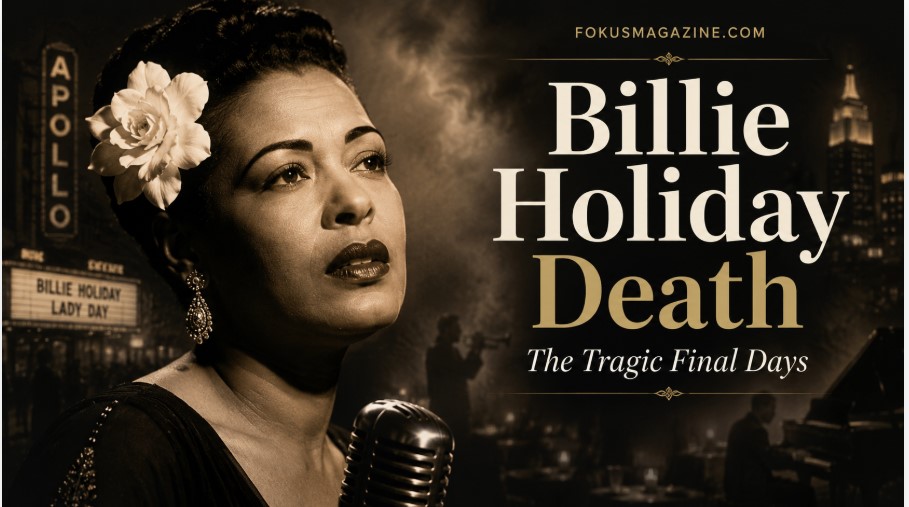
Some singers entertain you. Billie Holiday did something deeper. She made you feel as if every note had lived a full life before reaching your ears. Her voice was smoky, bruised, elegant, tired, brave, and painfully human. That is why the story of Billie Holiday Death still feels so emotional decades later.
- A Voice That Still Hurts in the Heart
- Billie Holiday Bio
- Who Was Billie Holiday?
- Billie Holiday Death: When Did She Die?
- The Tragic Final Days of Billie Holiday
- What Caused Billie Holiday Death?
- The Hospital Room Controversy
- Why Was Billie Holiday Targeted?
- Billie Holiday’s Health Struggles
- The Role of Addiction in Her Final Years
- Billie Holiday Death and Media Coverage
- Her Most Powerful Songs
- Why “Strange Fruit” Changed Everything
- Billie Holiday’s Final Performance Years
- How Old Was Billie Holiday When She Died?
- Billie Holiday’s Legacy After Death
- Common Myths About Billie Holiday Death
- Why People Still Search for Billie Holiday Death
- Lessons From Billie Holiday’s Life and Death
- Billie Holiday’s Impact on Modern Music
- A Human Look at Her Final Chapter
- Why Billie Holiday Still Matters Today
- Conclusion: The Tragic Final Days of a Voice That Never Died
She was not just a jazz singer. She was a storyteller. Every song sounded like a private confession. When she sang about love, loss, racism, loneliness, and heartbreak, people believed her because she had lived through so much of it.
But behind the glamour of the stage was a woman fighting battles that most fans never fully saw. Her final days were filled with illness, legal pressure, public judgment, and deep personal pain. The story of Billie Holiday Death is not only about how she died. It is also about how America treated one of its greatest artists when she was at her weakest.
This article looks at Billie Holiday’s life, her last days, her health struggles, the controversy around her hospital room, and why her legacy remains powerful today.
Billie Holiday Bio
| Detail | Information |
|---|---|
| Full Name | Eleanora Fagan |
| Date of Birth | April 7, 1915 |
| Age | 44 years old at the time of death |
| Profession | Jazz Singer, Songwriter, Performer |
| Nationality | American |
| Net Worth Approx. | Very limited at the time of death, despite her fame |
| Notable Works / Achievements | “Strange Fruit,” “God Bless the Child,” “Lover Man,” “Lady Sings the Blues,” Grammy Hall of Fame honors, major influence on jazz and popular music |
Who Was Billie Holiday?
Billie Holiday was born Eleanora Fagan in Philadelphia and raised mostly in Baltimore. Her early life was not easy. Poverty, instability, and hardship shaped her childhood. Yet somewhere inside all that pain, she found a voice that would later change American music.
She began singing in clubs as a young woman and slowly built a name for herself. People noticed something different about her. She did not have the loudest voice in the room. She did not sing with perfect polish. Instead, she bent notes, stretched phrases, and made every lyric sound personal.
Her nickname, “Lady Day,” was given to her by saxophonist Lester Young, one of her closest musical friends. It suited her. She carried style, pain, and grace all at once.
Before discussing Billie Holiday Death, it is important to understand why her life mattered so much. She helped shape jazz singing. She influenced generations of artists. Singers across blues, soul, pop, R&B, and jazz still study her phrasing today.
Billie Holiday Death: When Did She Die?
Billie Holiday died on July 17, 1959. She was only 44 years old.
Her death happened at Metropolitan Hospital in New York City. By that time, her body had been weakened by years of health problems, addiction, emotional stress, and liver disease. Her final weeks were painful and deeply controversial.
The official cause connected to Billie Holiday Death was heart failure related to liver disease and other serious health complications. However, many people believe the circumstances around her death were made even worse by the way authorities treated her while she was sick.
That is one reason the topic remains so powerful. Billie Holiday Death was not just a sad celebrity ending. It became a symbol of how fame, race, addiction, law enforcement, and public cruelty can collide around one vulnerable person.
The Tragic Final Days of Billie Holiday
In the last chapter of her life, Billie Holiday was very ill. Her liver was badly damaged. She had heart issues. She was physically weak and needed medical care.
She entered the hospital in 1959. Instead of being allowed to recover peacefully, she faced legal trouble even from her hospital bed. She was reportedly placed under police guard after narcotics were allegedly found. This detail has become one of the darkest parts of the Billie Holiday Death story.
Imagine being one of the most important singers of the 20th century, lying sick in a hospital room, and still being treated like a criminal before being treated like a human being. That image is hard to forget.
Her friends and supporters believed she deserved compassion, not punishment. Sadly, compassion was not always what she received.
What Caused Billie Holiday Death?
The common explanation for Billie Holiday Death includes heart failure and complications linked to liver disease. Years of alcohol use, drug addiction, stress, and poor health had taken a heavy toll on her body.
However, the full story is more layered than a simple medical note.
Several factors shaped her final condition:
- Long-term liver damage
- Heart-related complications
- Addiction struggles
- Poor physical health
- Emotional trauma
- Legal stress
- Racial discrimination
- Years of exhausting performances
- Lack of proper support during her most fragile moments
Her body was tired. Her spirit had been tested again and again. By the time she reached the hospital, she was already in serious condition.
Still, many fans and historians feel that the cruelty surrounding her final days made the tragedy even heavier.
The Hospital Room Controversy
One of the most painful parts of Billie Holiday Death is what happened while she was hospitalized. Instead of being remembered only as a patient in need of care, she was also treated as a suspect.
Reports say that police guarded her hospital room. She was allegedly arrested while lying ill. This has led many people to see her final days as an example of how addiction was handled with punishment instead of treatment.
Today, conversations about addiction are very different. Many people now understand that addiction is a health issue, not simply a moral failure. But during Billie Holiday’s time, public figures with addiction problems were often shamed, arrested, and destroyed in the press.
For a Black woman in the 1940s and 1950s, the pressure was even harsher. She faced racism in hotels, clubs, touring, media coverage, and law enforcement. The story of Billie Holiday Death cannot be separated from that reality.
Why Was Billie Holiday Targeted?
Billie Holiday’s song “Strange Fruit” made her more than a singer. It made her a political voice.
The song was a haunting protest against lynching in America. It was brave, disturbing, and unforgettable. When Billie Holiday performed it, audiences often sat in silence. The song did not allow people to look away from racial violence.
Because of that, some people in power did not like her. She was a Black woman singing about racism in a direct and emotional way during a dangerous time. Her voice carried truth, and truth can make powerful people uncomfortable.
Her addiction struggles gave authorities another way to pressure her. Over the years, she faced arrests and public humiliation. Many writers and historians have argued that her punishment was not only about drugs. It was also about control.
That is why Billie Holiday Death still feels connected to a bigger story about race, power, gender, and justice.
Billie Holiday’s Health Struggles
Billie Holiday lived a hard life, and her body carried the evidence.
She struggled with alcohol and drugs for many years. She also dealt with abusive relationships, financial problems, and emotional pain. The music industry celebrated her voice but did not always protect her as a person.
Her touring schedule was demanding. Performing night after night can be brutal, especially for someone already dealing with illness and addiction. In addition, Black performers often faced humiliating conditions while traveling. They could sing to packed rooms but still be denied basic dignity outside the stage.
This constant pressure damaged her health. By the time people began to fully understand how sick she was, it was too late.
The tragedy of Billie Holiday Death is that her suffering was visible, but not enough people stepped in with real help.
The Role of Addiction in Her Final Years
It would be unfair to talk about Billie Holiday Death without discussing addiction. However, it must be done with care.
Billie Holiday was not simply “a troubled singer.” She was a woman who survived deep pain. Addiction was part of her story, but it was not her whole identity.
Many people turn to substances because they are trying to escape something unbearable. In Billie’s case, her life included childhood trauma, racism, abusive relationships, public pressure, and constant judgment.
Addiction affected her health, career, and relationships. It also gave newspapers and authorities a way to reduce her entire life to scandal. That was unfair then, and it remains unfair now.
She should be remembered as a brilliant artist first. Her struggles matter, but they should not erase her talent, courage, or contribution to music.
Billie Holiday Death and Media Coverage
The media has always loved tragic stories, especially when they involve famous women. Billie Holiday was no exception.
During her life, newspapers often focused on her arrests, addiction, and personal problems. They did not always give equal attention to her artistry, intelligence, or influence. This created a narrow picture of who she was.
After Billie Holiday Death, the public began to look back with more sympathy. Over time, people started asking better questions. Why was she treated so harshly? Why was her pain turned into gossip? Why did the system punish her instead of helping her?
Those questions still matter today.
Modern readers are more aware of how media narratives can harm public figures. Billie Holiday’s story reminds us to look beyond headlines and see the human being underneath.
Her Most Powerful Songs
Billie Holiday’s music helps explain why her death still matters. Her songs were not just performances. They were emotional records of survival.
Some of her most important songs include:
| Song | Why It Matters |
|---|---|
| Strange Fruit | A powerful protest song against racial violence |
| God Bless the Child | A deeply personal song about independence and survival |
| Lover Man | One of her most emotional vocal performances |
| Lady Sings the Blues | A signature song tied to her life story |
| I’ll Be Seeing You | A tender song often linked with memory and loss |
| Don’t Explain | A heartbreaking song about love, betrayal, and silence |
| Good Morning Heartache | A classic expression of sadness and endurance |
These songs help keep her alive in public memory. Even people who know little about Billie Holiday Death often recognize the pain and beauty in her voice.
Why “Strange Fruit” Changed Everything
“Strange Fruit” deserves special attention because it changed the direction of Billie Holiday’s career and legacy.
The song painted a terrifying image of lynching in the American South. It was not gentle. It was not vague. It was direct, poetic, and painful.
When Billie Holiday sang it, she brought a quiet force to the stage. She did not need to shout. Her voice carried the weight of the lyrics with chilling control.
This song made her a target, but it also made her immortal. It proved that music could be more than entertainment. It could be witness. It could be protest. It could be history.
In many ways, the emotional weight behind “Strange Fruit” makes the story of Billie Holiday Death even more heartbreaking. She gave so much truth to the world, yet the world gave her very little peace in return.
Billie Holiday’s Final Performance Years
Even as her health declined, Billie Holiday continued to perform. Her later voice was rougher and thinner than in her younger years, but it had even more emotional weight.
Some listeners prefer her early recordings because they show her vocal beauty and playful phrasing. Others are drawn to her later recordings because they sound raw and honest. You can hear the scars. You can hear time.
That is the strange power of Billie Holiday. Technical perfection was never the point. Feeling was the point.
In her final years, every song sounded like a memory. Every pause carried meaning. Every crack in her voice told a story.
This is why Billie Holiday Death did not end her presence. In some ways, it made people listen even more closely.
How Old Was Billie Holiday When She Died?
Billie Holiday was only 44 years old when she died.
That number shocks many people. She sounded like someone who had lived many lifetimes, yet she was still young. If she had received better care, more compassion, and less punishment, perhaps her life could have lasted longer.
Of course, we cannot rewrite history. But we can learn from it.
The fact that Billie Holiday Death happened at such a young age adds to the sadness. She still had music left in her. She still had stories left to tell.
Billie Holiday’s Legacy After Death
After Billie Holiday Death, her reputation continued to grow. Today, she is seen as one of the most important singers in American history.
Her influence can be heard in many artists who came after her. Jazz singers, soul singers, blues artists, and pop vocalists have all learned from her timing, emotion, and phrasing.
She changed the way singers approach lyrics. Before Billie, many popular singers focused mainly on melody and clean delivery. Billie made the words feel lived-in. She sang behind the beat. She bent rhythm. She made silence part of the song.
Her legacy includes:
- A lasting impact on jazz vocals
- A fearless musical style
- A major role in protest music
- Influence on civil rights-era artists
- A voice that still feels modern
- Recognition as one of the greatest singers ever
- Continued interest through books, films, and documentaries
Billie Holiday did not live an easy life, but her art survived everything.
Common Myths About Billie Holiday Death
Because her life was dramatic and heavily discussed, many myths surround Billie Holiday Death. Some people only remember the addiction. Others only remember the tragedy. Both views are incomplete.
Myth 1: She Was Only Famous Because of Tragedy
This is false. Billie Holiday was famous because she was brilliant. Her tragedy shaped her story, but her talent made her unforgettable.
Myth 2: Her Voice Was Technically Weak
Billie Holiday did not sing like a classical vocalist, but she had extraordinary control over emotion, phrasing, and timing. That is a different kind of mastery.
Myth 3: Her Death Defines Her Life
Her death was tragic, but it should not define everything. She was also funny, stylish, sharp, brave, and deeply creative.
Myth 4: She Was Simply a Victim
She suffered, yes. But she also fought, created, performed, and influenced the world. She had agency, courage, and artistic power.
Why People Still Search for Billie Holiday Death
People search for Billie Holiday Death because they want to understand what happened to her. But often, they are looking for more than medical facts.
They want to know why such a gifted woman suffered so much. They want to understand the final days of a jazz legend. They want to know how fame can exist beside loneliness. They want to know why her music still hurts in such a beautiful way.
There is also a modern reason. Today, many readers are rethinking the stories of famous women who were judged harshly in their time. Billie Holiday belongs in that conversation. She was talented, complex, wounded, and powerful.
Her story asks us to be more careful with public figures, especially those struggling with addiction or trauma.
Lessons From Billie Holiday’s Life and Death
The story of Billie Holiday Death offers several important lessons.
Talent Does Not Protect People From Pain
Billie Holiday was admired by audiences, musicians, and critics. Still, fame did not save her from illness, addiction, racism, or loneliness.
Compassion Matters
Her final days show why people in crisis need care, not shame. Addiction and illness should be met with treatment and support.
Art Can Outlive Injustice
Even though Billie Holiday faced cruelty, her music survived. Her songs still teach, comfort, and challenge listeners.
The Media Should Tell Fuller Stories
No person should be reduced to their worst moments. Billie Holiday was more than scandal. She was an artist of rare emotional power.
History Must Be Remembered Honestly
The story of Billie Holiday Death is painful, but it should not be softened too much. The truth matters because it helps us understand both the artist and the world around her.
Billie Holiday’s Impact on Modern Music
Billie Holiday’s influence is everywhere, even when people do not realize it.
Modern singers who play with timing, emotion, and phrasing owe something to her. She showed that a singer does not need to overpower a song. Sometimes the quietest delivery can leave the deepest mark.
Her emotional honesty opened the door for later artists to sing with vulnerability. She helped make sadness beautiful without making it fake. She proved that pain could become art without losing its truth.
That is why the conversation around Billie Holiday Death continues. Her ending was tragic, but her influence did not end. It moved forward through every singer who learned how to turn personal pain into sound.
A Human Look at Her Final Chapter
It is easy to turn Billie Holiday into a symbol. She was a jazz icon. A protest singer. A tragic star. A victim of racism. A woman harmed by addiction. All of that is true in some way.
But she was also a person.
She laughed. She loved dogs. She cared about style. She had friends. She could be difficult, warm, funny, guarded, generous, and wounded. Like all real people, she was complicated.
When we talk about Billie Holiday Death, we should not talk about her as if she was only a sad ending. She was a full human being. Her final days were tragic, but her life was also filled with music, courage, and moments of beauty.
That balance matters.
Why Billie Holiday Still Matters Today
Billie Holiday matters because her voice still feels alive. It does not sound trapped in the past. It sounds close, almost like someone speaking directly to you across time.
Her music remains important for jazz fans, history lovers, civil rights scholars, and anyone who cares about emotional storytelling. She stands at the center of American music because she changed what singing could be.
The story of Billie Holiday Death also matters because it reminds us how society treats vulnerable people. It asks whether we punish pain or try to heal it. It asks whether we judge too quickly. It asks whether we listen carefully enough.
Billie Holiday gave the world her voice. The least we can do is hear the whole story.
Conclusion: The Tragic Final Days of a Voice That Never Died
Billie Holiday Death remains one of the most heartbreaking stories in music history. She died young, sick, and surrounded by controversy. Her final days were marked by illness, legal pressure, and the heavy cost of a life filled with pain.
Yet Billie Holiday’s story is not only tragic. It is also powerful.
She turned suffering into art. She sang songs that still stop people in their tracks. She gave emotional truth to jazz and helped shape the future of American music. Even now, her voice carries a rare kind of honesty. It sounds fragile, but it never breaks completely.
That is her miracle.
Billie Holiday died at 44, but Lady Day never truly disappeared. Her music still speaks. Her story still teaches. Her courage still matters.
If this article helped you understand the real story behind Billie Holiday Death, share it with someone who loves music history, jazz legends, or powerful stories about artists who changed the world. And if Billie Holiday’s songs have ever moved you, leave a comment and keep her voice alive.