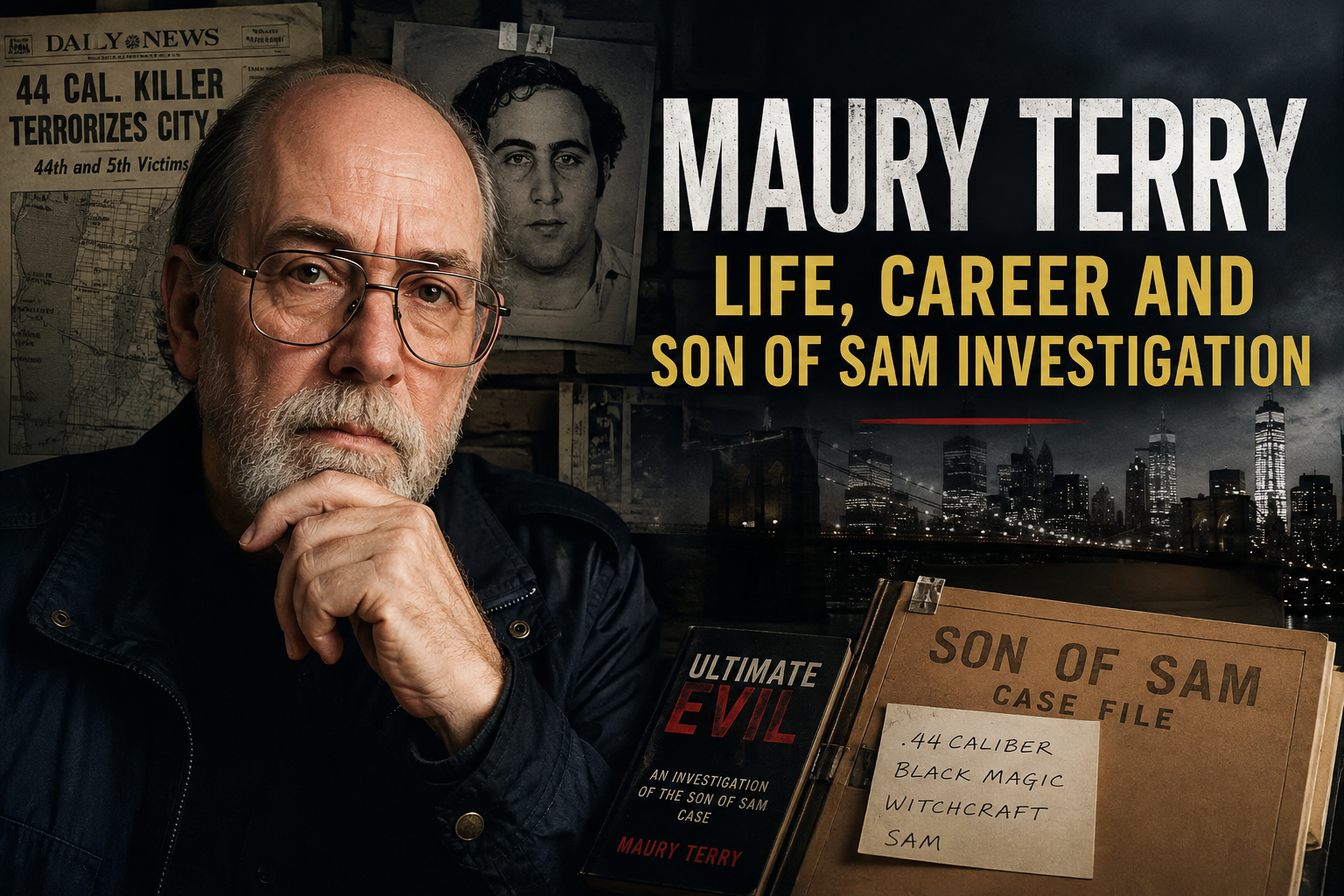

- Maury Terry: Life, Career and Son of Sam Investigation
- Key Takeaways
- Biography Table
- Who Was Maury Terry?
- Maury Terry and the Son of Sam Case
- Why Did Maury Terry Doubt the Official Story?
- The Ultimate Evil by Maury Terry
- Maury Terry’s Occult and Cult Theory
- Did Maury Terry Prove David Berkowitz Had Accomplices?
- Maury Terry’s Journalism Career
- Maury Terry and David Berkowitz
- The Personal Cost of the Investigation
- Maury Terry’s Death
- The Sons of Sam Documentary
- Maury Terry’s Legacy
Maury Terry: Life, Career and Son of Sam Investigation
Maury Terry became one of the most controversial investigative journalists associated with the Son of Sam case. What began as an interest in the 1976–1977 New York City murders eventually became a decades-long investigation that shaped his professional life, his public reputation, and his legacy.
Terry questioned the official account that convicted murderer David Berkowitz had acted entirely alone. He believed evidence pointed toward additional participants and, eventually, a much larger network connected to occult groups. His conclusions became the subject of his 1987 book, The Ultimate Evil, and later inspired the Netflix documentary series The Sons of Sam: A Descent into Darkness.
However, understanding Maury Terry requires an important distinction between what was established by law enforcement and what Terry theorized. His investigation raised questions that continue to interest true-crime audiences, but many of his broader claims remain disputed or unsubstantiated.
This article examines Terry’s life, journalism career, Son of Sam investigation, book, major theories, relationship with David Berkowitz, and lasting influence.
Key Takeaways
- Maury Terry was an American investigative journalist born in 1946 and died in 2015 at age 69.
- He became best known for challenging the official narrative surrounding the Son of Sam murders.
- His investigation culminated in the 1987 book The Ultimate Evil.
- Terry argued that David Berkowitz was connected to other people and an alleged occult network.
- His theories became increasingly controversial and were never established as the accepted explanation for the murders.
- Terry’s research and archives later became central to the 2021 Netflix documentary The Sons of Sam: A Descent into Darkness.
Biography Table
| Detail | Information |
|---|---|
| Full Name | Maurice P. Terry |
| Date of Birth | June 29, 1946 |
| Age at Death | 69 |
| Birthplace | Yonkers, New York, United States |
| Nationality | American |
| Profession | Investigative journalist, writer, television news producer |
| Education | Sacred Heart schools; attended Iona College |
| Years Active | Primarily from the 1970s onward |
| Known For | Investigating the Son of Sam case and writing The Ultimate Evil |
| Major Achievements | Award-winning investigative reporting; television and print journalism; author of The Ultimate Evil |
| Estimated Net Worth | Not reliably documented |
Biographical and obituary records identify Terry as a writer, television news producer, and award-winning investigative journalist. He attended Iona College and died in Yonkers, New York, on December 10, 2015, following a brief illness.
Who Was Maury Terry?
Maury Terry was an American journalist whose name became closely associated with one of the most notorious criminal investigations in New York history.
Before the Son of Sam case consumed much of his professional life, Terry worked in journalism and communications. He also worked as an in-house writer and editor at IBM. His professional experience eventually extended into television and print journalism, where he developed a reputation for investigative reporting.
His career changed direction after the arrest of David Berkowitz in August 1977.
Rather than accepting the case as completely solved, Terry began examining details surrounding the investigation. He focused particularly on witness descriptions, physical evidence, inconsistencies in the case narrative, and questions about whether Berkowitz had acted alone.
That skepticism became the foundation of his life’s most famous investigation.
Maury Terry and the Son of Sam Case
The Son of Sam murders terrified New York City during the mid-1970s. David Berkowitz was arrested on August 10, 1977, and ultimately convicted for the shootings that killed six people and wounded seven others.
For authorities, Berkowitz was the central perpetrator.
For Maury Terry, however, the arrest did not answer every question.
Terry became convinced that there were other people involved. His investigation focused on information he believed had not received sufficient attention, including witness accounts and connections involving individuals in the Yonkers area.
Over time, his theory expanded.
What initially looked like an investigation into whether Berkowitz had accomplices developed into a much broader theory involving alleged cult activity, ritual violence, and connections between different criminal cases.
That evolution is important because Terry’s work cannot be understood simply as an alternative account of the Son of Sam shootings. It eventually became a much larger theory about an alleged hidden network.
Why Did Maury Terry Doubt the Official Story?
Terry’s skepticism developed from several details that he believed did not fit neatly into the official account.
Among the issues he examined were:
- Conflicting descriptions of the shooter
- Questions about the locations and movements of suspects
- Witness accounts that Terry believed deserved greater attention
- The possibility that Berkowitz had assistance
- Connections between people associated with the case
- Alleged similarities between the Son of Sam crimes and other violent incidents
Terry did not view these issues as isolated anomalies. He believed they formed a larger pattern.
This approach became the defining characteristic of his investigation.
Importantly, questioning aspects of a criminal investigation is not the same as proving an alternative theory. Terry’s work generated controversy precisely because he moved from individual inconsistencies to increasingly expansive conclusions.
The Ultimate Evil by Maury Terry
The most important written product of Terry’s investigation was The Ultimate Evil.
First published in 1987, the book presented Terry’s argument that the Son of Sam crimes involved more than David Berkowitz. It connected the murders to an alleged satanic or occult network and examined Terry’s broader interpretation of the evidence.
The book became the defining work associated with his name.
Terry spent years collecting material for the investigation, and the book reflected the enormous amount of time he had devoted to the case. A later edition was republished with an introduction by filmmaker Joshua Zeman, who subsequently used Terry’s surviving research materials in his documentary project.
What Was the Main Argument of The Ultimate Evil?
At its core, Terry’s argument was that the Son of Sam crimes could not be adequately explained by Berkowitz acting independently.
He proposed that Berkowitz was connected to a broader group and that the murders were part of a larger pattern.
The book therefore combined:
- True-crime investigation
- Witness testimony
- Criminal case analysis
- Alleged occult connections
- Media reporting
- Terry’s interpretation of physical and circumstantial evidence
The book remains significant because it documents Terry’s investigative worldview, even where readers disagree with his conclusions.
Maury Terry’s Occult and Cult Theory
The most controversial aspect of Terry’s work was his belief that the Son of Sam murders were connected to an occult network.
He became particularly interested in alleged connections between Berkowitz and groups associated with satanism and occult activity. Terry’s theory eventually expanded beyond the Son of Sam shootings to include other violent crimes and historical cases.
This placed Terry’s work within a broader cultural environment that became associated with the Satanic Panic of the late 20th century.
The distinction between evidence and interpretation is especially important here.
Terry sincerely pursued his theory, but the existence of his investigation does not establish the truth of every conclusion he reached. Later accounts of his work have emphasized how his increasingly expansive theory became difficult to separate from his personal conviction that he had uncovered a much larger conspiracy.
Did Maury Terry Prove David Berkowitz Had Accomplices?
No definitive public finding established Terry’s broader theory that the Son of Sam murders were orchestrated by a satanic cult.
Terry’s central contention was that Berkowitz did not act entirely alone. He gathered information and developed arguments intended to support that position.
David Berkowitz himself later made statements that Terry interpreted as supporting aspects of his theory. The relationship between Berkowitz’s statements and Terry’s conclusions, however, remains a subject of debate.
This is why responsible accounts of Maury Terry should distinguish between:
| Established fact | Terry’s theory |
|---|---|
| David Berkowitz was arrested and convicted | Berkowitz was part of a larger network |
| The Son of Sam shootings killed six people and wounded seven | The crimes were connected to an occult organization |
| Berkowitz was the central convicted perpetrator | Additional people participated in the crimes |
| Terry investigated the case for years | A broader conspiracy explained the evidence |
The distinction matters. Terry’s investigation is historically interesting, but his conclusions should not automatically be presented as proven facts.
Maury Terry’s Journalism Career
Although the Son of Sam case dominates his legacy, Terry’s career was broader than a single investigation.
He worked across print and television and contributed to publications and media organizations including the Gannett newspaper chain, Vanity Fair, Gear, and Penthouse. He also worked on television productions and reported on or coproduced numerous national television specials connected with the Son of Sam story.
His professional background helps explain why his Son of Sam investigation became so extensive.
Terry was not simply an amateur researcher posting theories about a famous crime. He had experience gathering information, interviewing people, working with media organizations, and producing investigative material.
At the same time, professional journalism does not automatically validate an investigative conclusion. The strength of a journalist’s work ultimately depends on the evidence, verification, corroboration, and reasoning behind it.
Maury Terry and David Berkowitz
The relationship between Maury Terry and David Berkowitz became one of the most unusual elements of the investigation.
Terry eventually interviewed Berkowitz directly. Netflix’s documentary describes a 1993 interview in which Berkowitz provided information that Terry viewed as supporting his theories.
For Terry, these conversations were extremely important.
They appeared to offer confirmation for ideas he had been developing for years.
But Berkowitz’s statements have to be considered carefully. A convicted serial killer’s later claims about his own crimes are not automatically reliable evidence, particularly when those claims support a theory that already existed.
That makes the Terry-Berkowitz relationship fascinating from both a true-crime and journalistic perspective.
The Personal Cost of the Investigation
The Son of Sam investigation was not simply a professional assignment for Terry. It gradually became a dominant part of his identity.
Accounts of his later years describe a journalist increasingly consumed by the case. The New Yorker noted that his investigation eventually affected his personal life, including his marriage and health.
That personal dimension is central to understanding his legacy.
Terry’s story raises a difficult question faced by investigative journalists and researchers: At what point does persistence become fixation?
Persistence can uncover information that others overlook. But once a researcher becomes convinced that a particular theory must be true, confirmation bias can make contradictory evidence harder to accept.
Terry’s career illustrates both sides of that tension.
Maury Terry’s Death
Maury Terry died on December 10, 2015, at the age of 69, following a brief illness. He died in Yonkers, New York.
By that point, the Son of Sam investigation had defined much of his public identity.
His death did not end interest in his research. Instead, his surviving files and materials eventually became the foundation for a new examination of his life and theories.
The Sons of Sam Documentary
Interest in Maury Terry grew substantially after the release of Netflix’s four-part documentary series The Sons of Sam: A Descent into Darkness in 2021.
Directed by Joshua Zeman, the documentary examines both the Son of Sam case and Terry’s decades-long pursuit of his theory. Netflix describes the series as following Terry’s investigation and his belief that the murders were connected to a satanic cult.
The series is unusual because Terry is not simply the subject of the investigation. His own investigative journey becomes part of the story.
The documentary uses archival material connected with Terry’s work and examines how his search for answers gradually transformed his life.
What Does the Documentary Show?
The four episodes cover different stages of the story, including:
- The original Son of Sam murders and Berkowitz’s arrest
- Terry’s investigation into possible accomplices
- His development of the occult-cult theory
- His later efforts to validate his conclusions
The final episodes place particular emphasis on Terry himself and the consequences of his increasingly consuming investigation.
Maury Terry’s Legacy
The legacy of Maury Terry is complicated.
For some readers and true-crime audiences, he represents a determined investigator who was willing to challenge an official narrative. His willingness to keep investigating after the case was considered solved is part of what makes his story compelling.
For critics, however, Terry’s later work demonstrates the dangers of allowing a theory to become stronger than the evidence supporting it.
Both perspectives are important.
His legacy can be understood through several areas:
Investigative Journalism
Terry demonstrated the value of persistent research and questioning established narratives.
True Crime
The Ultimate Evil became an influential work within true-crime literature and remains closely associated with the Son of Sam mystery.
Media History
His investigation generated television coverage and later became the foundation for a major streaming documentary.
The Study of Conspiracy Theories
His story also provides an example of how genuine investigative questions can develop into increasingly expansive theories.
Why Maury Terry Still Interests Readers
Decades after the Son of Sam shootings, people continue searching for Maury Terry because his story combines several enduring interests: crime, journalism, unanswered questions, investigative persistence, and conspiracy theories.
There is also a broader lesson in his career.
Criminal investigations rarely consist of a single piece of evidence. They involve witness statements, physical evidence, timelines, police work, courtroom records, media coverage, and later interpretations.
Terry’s work encourages readers to examine those pieces critically.
But critical examination works both ways. Readers should question official accounts when evidence warrants it, while also questioning alternative theories when their evidence is weak or incomplete.
That balance is essential when studying controversial historical crimes.
Frequently Asked Questions
Who was Maury Terry?
Maury Terry was an American investigative journalist best known for his decades-long investigation into the Son of Sam murders. He later published his theories in The Ultimate Evil.
When was Maury Terry born?
Maury Terry was born on June 29, 1946. Biographical records identify Yonkers, New York, as his birthplace.
When did Maury Terry die?
Maury Terry died on December 10, 2015, at age 69, following a brief illness.
What book did Maury Terry write?
His best-known book was The Ultimate Evil, first published in 1987. It presented his theory that the Son of Sam crimes involved a broader network rather than David Berkowitz acting alone.
Did Maury Terry believe David Berkowitz acted alone?
No. Terry strongly rejected the idea that Berkowitz had acted entirely alone and spent years investigating alleged accomplices and connections to a wider network.
Was Maury Terry’s cult theory proven?
No. Terry’s broader theory about an occult or satanic network was never established as the accepted explanation for the Son of Sam murders. His claims remain controversial and disputed.
Is Maury Terry featured in a Netflix documentary?
Yes. Terry is the central figure of The Sons of Sam: A Descent into Darkness, a four-part Netflix documentary series released in 2021.
What is Maury Terry best known for?
He is best known for his investigation of the Son of Sam case and for The Ultimate Evil, the book in which he presented his theory of a larger conspiracy behind the murders.
Conclusion
Maury Terry remains a fascinating and controversial figure in American investigative journalism. His career was shaped by a willingness to challenge the official explanation of the Son of Sam murders, but it was also shaped by the risks that come with pursuing a theory for decades.
His book, The Ultimate Evil, preserved his interpretation of the case and ensured that his investigation would continue to attract attention long after his death. The later Netflix documentary brought his story to a new generation, presenting not only his theories but also the personal consequences of his obsession with the case.
The most useful way to understand Terry is neither to dismiss everything he investigated nor to accept every conclusion he reached. His story is better approached as a study in investigative journalism: how questions emerge, how evidence is interpreted, how theories develop, and how difficult it can become to distinguish a legitimate unanswered question from a conclusion that the available evidence cannot firmly establish.
That complexity is ultimately what makes Maury Terry and his Son of Sam investigation continue to attract attention decades later.